



Recent searches
Recommended for you


Search results
Searching…
No products found. Try a different search term.
No products found. Try a different search term.

Baby wipes are one of the most-used products in any Indian household with a young child, yet most parents have never been told exactly what's in them, how often newborn skin can safely handle them, or which ingredients to actively avoid. This guide answers all three.
Quick Summary
Baby wipes are pre-moistened, disposable cloths designed to clean a baby's skin — most commonly during diaper changes, but also for the face, hands, and body. They are typically made from a soft non-woven fabric saturated with a solution of purified water and, depending on the formulation, mild cleansing agents, moisturisers, or plant extracts. The goal of any well-formulated baby wipe is to replicate the gentleness of cleaning with cotton and water while adding convenience for everyday use.
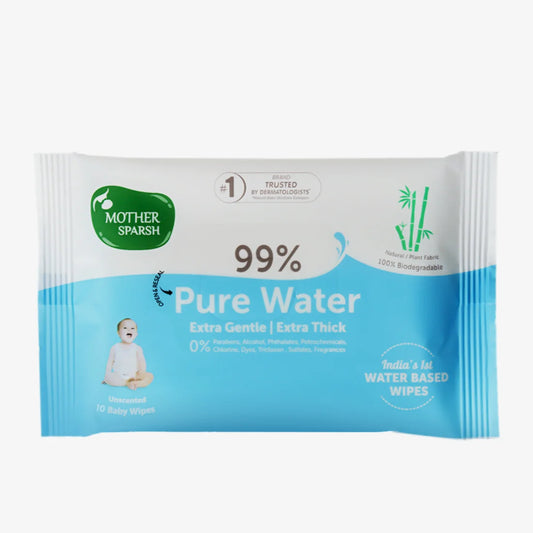
Not all baby wipes are formulated the same way. The two broad categories you'll find in the Indian market are water-based wipes (98–99% purified water with minimal additives) and standard wet wipes, which use a higher concentration of cleansing agents, fragrance, or preservatives. The distinction matters more than most parents realise — see the comparison below.
| Factor | Water-Based Wipes | Standard Wet Wipes |
|---|---|---|
| Water content | 98–99% purified water | Typically 80–90% |
| Alcohol / parabens | Free from both | May contain trace amounts as preservatives |
| Fragrance | Unscented or naturally derived | Often synthetically scented |
| Best suited for | Newborns, sensitive or rash-prone skin | Older infants and toddlers with no skin sensitivity |
| pH balance | Formulated close to skin-neutral pH (~5.5) | Varies by brand; not always disclosed |
The skin around a baby's diaper area stays moist for extended periods and has folds that are difficult to clean thoroughly with a dry cloth. Wipes allow for quicker, more consistent cleaning, which directly reduces the time bacteria and moisture sit against the skin — a key factor in preventing diaper rash. For parents managing multiple diaper changes a day, the convenience factor also matters: a wipe is ready to use immediately, with no need to warm water or locate a clean cloth.
That said, convenience should never come at the cost of skin safety. The American Academy of Dermatology notes that infant skin has a thinner outer barrier than adult skin, making it more permeable to irritants — which is why ingredient choice matters more for babies than it does for adults.1
Newborn skin (0–3 months) has a less developed acid mantle than older infant skin, meaning it's more vulnerable to dryness and irritation from fragrance, alcohol, and even some plant extracts that are otherwise considered "natural." For this age group:
Reading the ingredient list is the single most useful habit a parent can build. Look for these markers of a safe formulation:
99% Pure Water Unscented Baby Wipes
Q1. What are baby wipes made of?
Baby wipes are made from a non-woven fabric (often cotton-based or plant-fibre) saturated with a solution that is primarily purified water, combined with mild cleansing agents and, in some formulations, moisturising extracts like aloe vera.
Q2. Are baby wipes safe to use on newborns from day one?
Yes, provided they are unscented, alcohol-free, and water-based (98%+ purity). Always patch-test a new brand on a small area before full use, and consult your paediatrician if your baby has eczema or another skin condition.
Q3. How many baby wipes can I use per day?
There's no strict daily limit — frequency should match diaper changes (typically 6–8 times a day for newborns). The priority is formulation safety, not quantity.
Q4. What ingredients should I avoid in baby wipes?
Avoid alcohol, parabens, synthetic fragrance, phthalates, and chlorine bleach. These are the ingredients most commonly linked to skin dryness and irritation in infants.
Q5. How long do baby wipes stay moist after opening?
If resealed properly after every use, an opened pack typically stays moist for 4–6 weeks. Unopened packs remain fresh for up to 24 months. Storing the pack in a cool, dry place away from direct sunlight extends shelf life.
Q6. Can I use baby wipes instead of bathing my baby?
Wipes are suitable for spot-cleaning between baths but shouldn't fully replace regular bathing, which is needed for overall hygiene and skin health.
References:
1. American Academy of Dermatology Association — Baby Skin Care Guidelines. aad.org
This article is for general informational purposes and is not a substitute for professional medical advice. Consult a paediatrician for concerns specific to your baby's skin.


