



Recent searches
Recommended for you


Search results
Searching…
No products found. Try a different search term.

No products found. Try a different search term.
Baby Sunscreen
SPF 50 Protection From Harmful UVA & UVB RaysAvailable in : 50g
Couldn't load pickup availability
ESTIMATED DELIVERY BETWEEN to


Sunny days often mean warm sunshine, balcony playtime or fun time in the park. During these moments, your baby’s delicate skin needs gentle sun protection. Mother Sparsh Natural Care Baby Sunscreen Lotion with SPF 50 PA+++ helps shield your little one from harmful UVA and UVB rays while they enjoy time outdoors. Made for babies 6 months and above, this gentle sunscreen can be used on both the face and body.
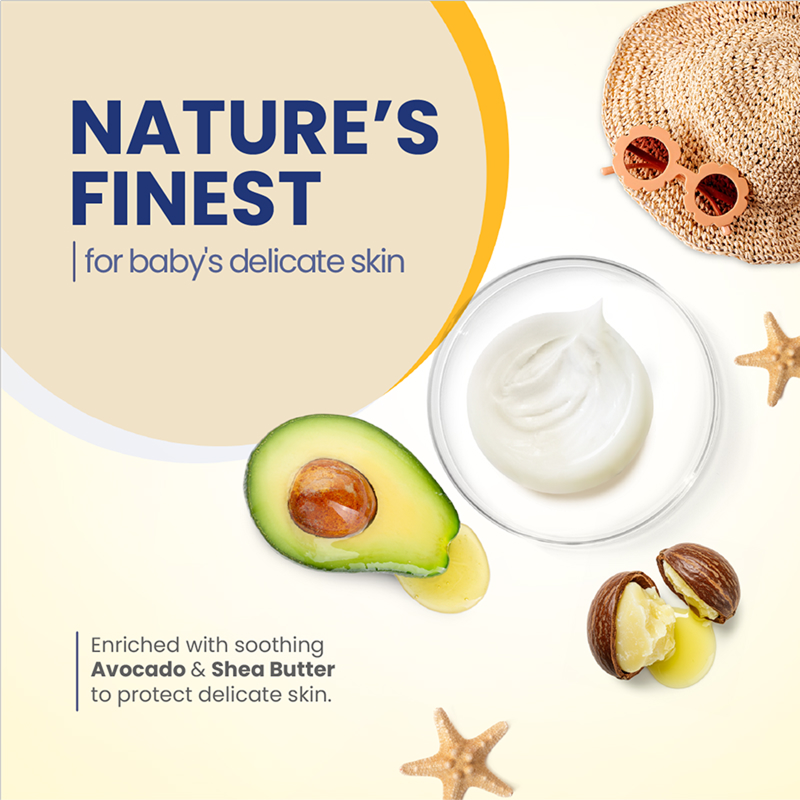
The smooth lotion spreads easily and absorbs quickly without leaving a heavy or greasy feel, keeping your baby comfortable during everyday play. It is enriched with antioxidant-rich avocado oil, deeply moisturising shea butter, soothing oatmeal extract and nourishing Vitamin E to help keep skin soft, calm and hydrated.
Thoughtfully crafted with no added parabens and SLS/SLES, this sunscreen is designed for gentle everyday sun care. Because when your baby steps out to discover the world, their skin deserves protection that feels safe, simple and trusted.
 High UV Protection
 Water Resistant
 Safe for 6+ Month

A combination of modern UV filters helps protect delicate skin from both UVA rays and UVB rays that can cause sunburn.
Enriched with nourishing ingredients like avocado oil and shea butter to help keep your baby’s skin soft, smooth, and hydrated.


Helps the sunscreen stay effective during outdoor play, sweating, or light water exposure, keeping your baby protected for longer.


Protect delicate skin from harmful UVA and UVB rays

Deeply nourishes skin & helps keep it moisturised

Helps hydrate and support skin barrier
Toll Free No : 18001213694
WhatsApp : 9817700876
Email : contact@mothersparsh.com
SPF stands for Sun Protection Factor. It indicates how well a sunscreen protects the skin from UVB rays, which are the main cause of sunburn. SPF is calculated as the ratio of the minimum erythemal dose (MED) on protected skin to the MED on unprotected skin. In simple terms, SPF shows how much longer the skin is protected from sun exposure when sunscreen is applied properly.
Important: SPF mainly measures UVB protection, not UVA protection.
SPF Protection Categories V/S Protection Class| Label SPF | Protection Class |
|---|---|
| SPF 10 | Low Protection |
| SPF 15, 20, 25 | Medium Protection |
| SPF 30, 40, 50 | High Protection |
| SPF 50+ | Very High Protection |
The dark pigment that gives skin its natural colour is called melanin. Melanin is produced by special skin cells known as melanocytes. When skin is exposed to sunlight, melanocytes produce more melanin to absorb harmful UV radiation. This causes the skin to become darker, a process known as tanning.
‘Tanning is actually a sign of skin damage and indicates that the skin is trying to protect itself from UV exposure.’
Everyone, regardless of age, gender or skin type, should use sunscreen. Regular use of sunscreen helps protect the skin from harmful ultraviolet (UV) rays and reduces the risk of sun damage.
(UV) radiation from the sun has three forms:
* UVC rays do not reach the earth’s surface, so protection is mainly required against UVA and UVB rays.
UVA Rays
UVB Rays
A sunscreen with broad-spectrum protection helps protect against both UVA and UVB rays.
UVA protection labelling helps consumers understand degree of protection from UVA rays and how effectively a sunscreen protects against long-term skin damage, such as premature ageing and pigmentation. Since SPF labelling does not indicate UVA protection, clear UVA labelling (PA rating) ensures awareness on UVA + UVB spectrum protection and Broad Spectrum protection status offered by a sunscreen product.
When you buy sunscreen containing UVA protection, you may notice a PA+/++/ +++/++++ rating on the packaging. The PA rating ranging from + to ++++ indicates the level of protection from UVA radiation.
Organic filters absorb harmful UV radiation and convert and give this energy back out as infrared. These are sometimes known as ‘absorbers’, or ‘chemical’ sunscreens. Note that organic filters does not mean ‘organic’ in the environmental sense. Inorganic filters (also known as ‘physical’, ‘natural’, ‘reflective’, ‘zinc’) contain titanium dioxide or zinc oxide, which reflect UV radiation away from the skin. It can be helpful to think of organic filters as sponges, mopping up the UV radiation, and inorganic filters as mirrors, bouncing UV straight back off the skin.
A broad spectrum sunscreen provides protection against both UVA and UVB rays. This helps prevent sunburn, premature skin ageing, tanning, persistent pigment darkening and long-term skin damage.
For effective protection, apply a generous amount of sunscreen to all exposed skin.
Sunscreen should be reapplied every 2 hours, or more frequently:
Regular reapplication is essential to maintain protection.
Every day you go outside. The sun emits harmful UV rays year-round. Even on cloudy days, up to 80 percent of the sun’s harmful UV rays can penetrate your skin. Snow, sand and water increase the need for sunscreen because they reflect the sun’s rays.
Yes. UVA rays can penetrate glass, so sunscreen is recommended even indoors if you are exposed to sunlight through windows or screens.
Yes. Up to 80% of UV rays can penetrate clouds, which means skin can still be damaged even on overcast days.
Sunscreen products should not be used as a means to stay in the sun for prolonged periods. Over exposure to the sun can be harmful, and the use of sunscreen is one part of “sun-safe” behaviour.
Always read the label and choose the most appropriate product based on your skin sensitivity and the conditions under which you will be exposed to the sun. UV ray intensity will depend on the time of day, your geographical location and the weather.
No, you can still get a tan while wearing a high factor SPF. Wearing sunscreen will lower your risk of skin damage.
Using sunscreen may decrease your skin’s production of vitamin D.
A-13.1 If you are concerned that you are not getting enough vitamin D, you should discuss your options for getting vitamin D with your doctor.
A-13.2 Many people can get the vitamin D they need from foods and/or vitamin supplements. This approach gives you the vitamin D you need without increasing your risk for skin cancer.
.
The higher the number, the greater the protection. But do not think of the SPF number as a mathematical formula indicating multiples of the amount of time you can stay out in the sun without sunscreen before you burn. Choose an SPF that suits your skin and the way in which you apply sunscreen.
Sunscreen products that offers the following maybe used depending on the time of day, your geographical location and the weather.
-Broad-spectrum protection (protects against UVA and UVB rays)
-SPF 10 or higher
-UVA PF (PA +/++/+++/++++)
-Water resistance (40 minutes/ 80 minutes)
A sunscreen that offers the above helps to protect your skin from sunburn, early skin aging and skin cancer. However, sunscreen alone cannot fully protect you. In addition to wearing sunscreen, dermatologists recommend taking the following steps to protect your skin and find skin cancer early:
-Seek shade when appropriate, remembering that the sun’s rays are strongest between 11 a.m. and 3 p.m.
-Dress to protect yourself from the sun by wearing loose-fitting clothing and a wide-brimmed hat with a good pair of sunglasses, when possible.
-Use extra caution near water, snow and sand as they reflect the damaging rays of the sun, which can increase your chance of sunburn.
-Get vitamin D safely through a healthy diet that may include vitamin supplements.
-Avoid tanning beds.
- Keep babies and young children out of direct sunlight.
Yes. Sunscreen is safe for daily use and should be part of your everyday skincare routine, even when there is no direct sun exposure.
Sunscreen reduces tanning and sun damage, but no sunscreen can block 100% of UV rays. Proper application and regular reapplication improve effectiveness.
Higher SPF provides greater UVB protection, but no SPF offers complete protection.
Example:
Sunscreens formulated for sensitive skin are generally dermatologically tested and designed to minimize irritation.
A patch test is recommended before first use.Lack of sunscreen use can lead to:
Couldn't load pickup availability


 Shipping
 Enquiry